
Identify Who Owns an Iron County Property
Start with the parcel, not a broad name hunt. Iron County's BS&A landing page takes an Address, a Name, or a Parcel Number. An address is the easiest way in, but the parcel number is the true anchor. That APN links the assessor's records, the tax roll, the GIS map, and recorded deeds into one clean chain.
- Search the address in Iron County BS&A Online.
- Copy the complete parcel number, legal-description clue, and assessed owner name.
- Use the same land description and owner name in the county-linked deed index.
- Find the newest conveyance and compare its grantee with the assessment-roll name.
- If an entity, trust, or estate appears, follow that official record without replacing the deed as ownership evidence.
Each step adds a stronger check. Searching Iron County property records this way catches the usual surprises too. A mailing city may not match the parcel's actual jurisdiction. And a tax roll can lag behind a freshly recorded deed, so the owner of record shown may briefly differ from the deed records themselves.
Start an Iron County Owner Search in BS&A
The BS&A screen lays out three tabs in order: Address, Name, and Parcel Number. Address and Name take plain text. The Name format runs surname first, while Parcel Number uses a fixed masked entry. Alongside the property search tabs, the screen also lists Detailed Record Search, Current Tax Search, Delinquent Tax Search, and Pay a Bill, though the county has not published labels for every result card.
| Search mode | Entry | Best owner use |
|---|---|---|
| Address | Property street address | Begin when only the location is known |
| Name | Owner text such as surname, given name | Check possible holdings and name variants |
| Parcel Number | 999-999-999-99 | Return to one exact tax account |
The official Iron County BS&A entry screen shows these three lookup paths.
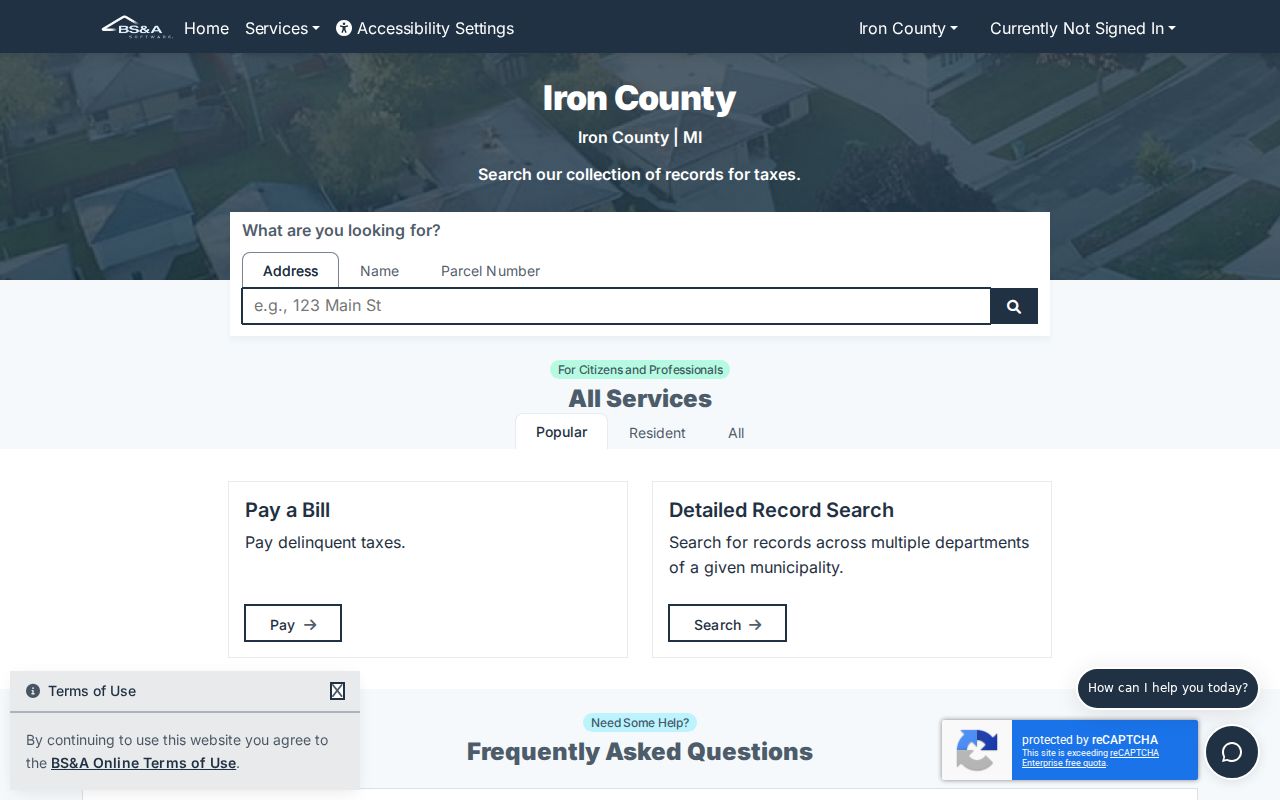
The screen confirms which search modes exist. It says nothing more, so treat any extra claim with care. Iron County has not published a historical coverage span for its property records. It has not published a refresh schedule either. Inventing one would mislead. Trust the modes you can see and leave the rest alone.
Note: Keep every leading zero in the APN. Carry it that way from BS&A into any other Iron County property records source.
Three Iron County Records That Point to an Owner
No single record answers every ownership question on its own. The assessment roll offers a fast name, the recorder's deed records supply the actual conveyance evidence, and the GIS map helps confirm that those records describe the right Iron County land.
| Where ownership is shown | What it gives | How current |
|---|---|---|
| BS&A assessment roll | Assessed owner/name role, parcel, address and locally maintained land data | Current roll, but no published refresh interval |
| Register of Deeds index and copy | Most recent recorded grantee and legal description | A just-recorded deed can be newer than the roll |
| Colligo GIS | Map context and parcel identifier where coverage exists | Partial tax-reference coverage, not title proof |
Iron County posts its Iron County land-record index as a link. The page can fail to load. The county publishes no start year for online records, no image cost, and no list of result fields. Update timing is likewise unstated. When the link fails, a visit to the Register of Deeds counter still works. A simple search request also gets results.
Trace the Iron County Name to the Latest Deed
The assessment roll is only a clue. The newest deed confirms who the owner of record really is, because it names the grantor, the grantee receiving the interest, and the legal description of the land. Search both the roll name and any variant spelling. Then compare the deed's legal description and APN against the parcel located in BS&A to make sure everything lines up.
- Owner of record
- The party carried as owner in the official roll or record being consulted.
- Grantee
- The person or entity receiving the stated interest in a recorded conveyance.
- Title
- The legal rights and interests in land, which cannot be proved by a name-only web result.
- Situs address
- The physical property location used to find the parcel.
- Mailing address
- The destination for notices, which may be elsewhere and is not proof of occupancy.
Owner name is not a title search. A roll can lag, and an LLC or trust may hold the interest. Confirm the latest instrument and use a title professional for a title opinion.
Follow an Iron County LLC Owner in MiBusiness
An LLC on the deed or the tax roll is not a dead end. Plug the exact legal entity name into Michigan's MiBusiness Registry Portal, which supports searches by entity name, individual name, nine-digit identification number, and filing number. Entity and individual lookups each offer Begins with, Exact match, Keyword, and Soundex modes. The Michigan Corporations Division provides the official route to that entity search.
MiBusiness registry entries answer a different question than a deed does. A filing shows an entity's status, registered office, and resident agent. It also lists annual statements. An officer, member, or agent is not automatically the personal owner of the land. A deed name alone will not settle that question.
The portal went live in June 2025. Work from the current interface. Keep the entity identification number alongside the deed reference. An assumed-name filing may also rest with the Iron County Clerk, tying a trade name back to its legal entity.
Resolve Trust and Estate Ownership in Iron County
A trust name on the tax roll raises questions the roll cannot answer. Pull the deed. It names the trustee or states the trust capacity under which title was taken. Do not assume a beneficiary, settlor, or anyone sharing a surname owns the parcel. With an estate, a death record or probate case may explain why a transfer happened. Yet only a later instrument shows how the land interest actually moved. That instrument could be a personal-representative deed. It could also be a probate order, an affidavit, a survivorship instrument, or another recorded conveyance.
Iron County Probate and Trial Court records can be searched through MiCOURT. Request the actual public file from the local clerk. MiCOURT is informational only. Restricted cases do not appear, and court access follows MCR 8.119. Whatever a probate search turns up, match it back to the recorded instrument. Do that before drawing a conclusion about the owner of record on the parcel.
Use Iron County Property Fraud Alerts as Notice
The Register of Deeds invites residents to contact the office and request Property Fraud Alert enrollment. The service sends notice after a document is recorded under a monitored name. That is its whole job. It does not block a filing. Nor does it prove a flagged document is fraudulent.
The Iron County Register of Deeds page explains the alert and the official routes into county deed records.
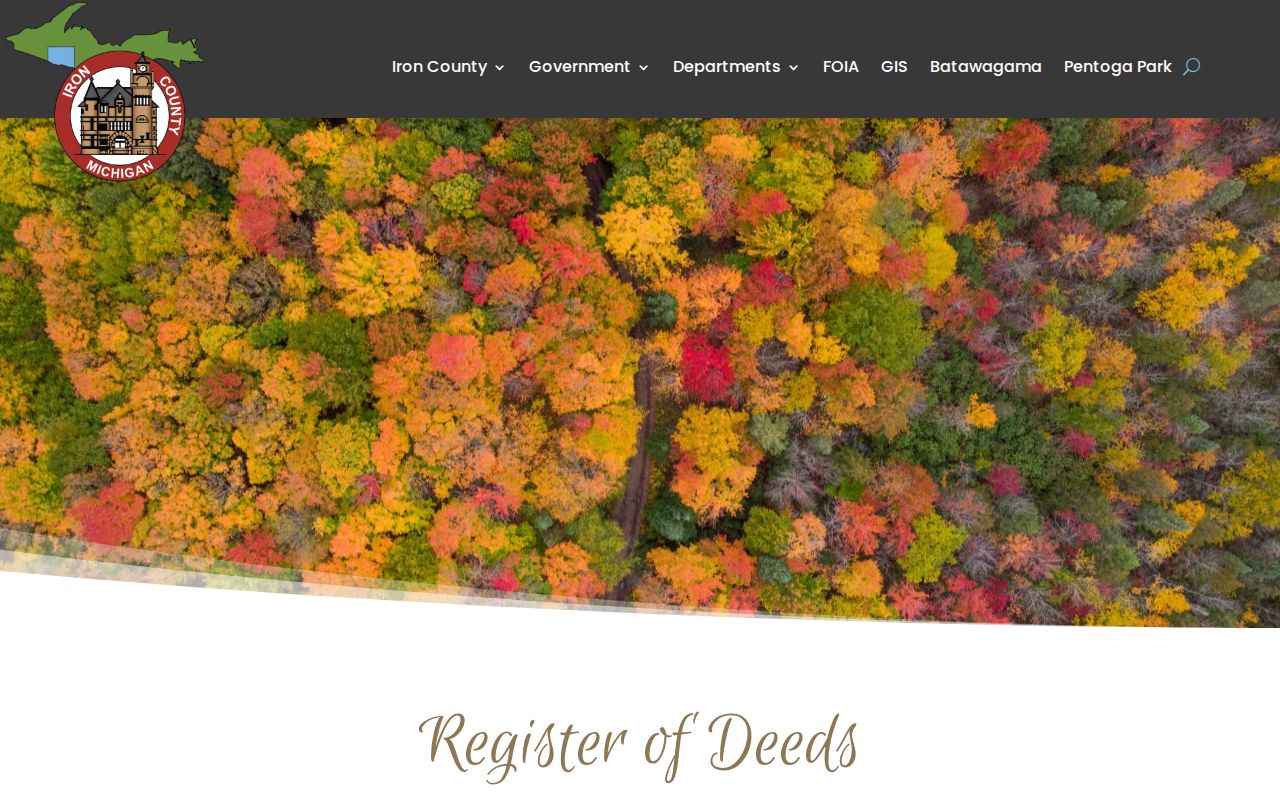
An unexpected alert deserves a calm response. Ask the office for the instrument and its recording reference. Preserve the notice, contact the Register of Deeds, and never pay an unsolicited service before the claim is verified through the county.
Separate Iron County Mailing and Situs Clues
A mailing address on a tax bill tells you where notices go, nothing more. It is not proof the owner lives there. Postal geography adds its own wrinkles. An Iron River address can fall within old Iron River, former Mineral Hills, or former Stambaugh. A Crystal Falls mailing address does not place the parcel inside city limits on its own.
The parcel number and legal description settle which piece of land is actually involved. Equalization keeps the name, address, and legal-description records when the situs is murky. E911 or the local city or township clerk can confirm the governmental unit.
Note: ZIP codes follow mail routes and may cross city or township lines. They prove neither ownership nor boundaries.
Limits on Asking Who Owns Iron County Property
Public records serve real purposes. They support purchase research, boundary disputes, estate work, fraud review, and plain civic transparency. But they cannot show who occupies a building. They cannot promise every private interest is visible online. A name shown on some site may not be fully current. Michigan's Address Confidentiality Program allows qualifying survivors to substitute a designated address in covered government records. Protected details should never be rebuilt from stale sources.
Lawful use. Use Iron County owner information for legitimate property research. Public access never permits stalking, threats, trespass, repeated unwanted contact, or efforts to defeat an address protection.
For present-record detail, turn to the Iron County current owner page. Older transfers need the deed chain instead. The method here ends once a likely owner has been identified and checked against the newest recorded conveyance.