
Trace Former Iron County Property Owners
Pull the current deed or assessor parcel card first. From there, the recorded deed chain leads backward, grantee by grantor. Iron County publishes no starting year for its online land-record index. So the first web result is never proof of the first owner. The courthouse vault, state archives, and historic plats carry the search well past whatever the portal exposes. Serious chain work eventually lands in all three.
| Source | Years It Covers | Where Held | What It Shows |
|---|---|---|---|
| Register of Deeds index | Online starting year not published | County-linked land-record index and courthouse | Grantor, grantee, instrument and recording trail |
| Vault deed books | Historic volumes, exact spans checked at counter | Register of Deeds, Crystal Falls courthouse | Earlier transfers, book and page references |
| Recorded plats | Varies by plat | Michigan OLSR and county records | Lot, block, subdivision name and attachments |
| Archive and library collections | Collection-specific | Archives of Michigan, Library of Michigan, Crystal Falls library | Maps, plat books, newspapers and historical context |
A recent transfer is easy: start with the assessor identity and the newest recorded deed. Older owners whose names vanish from online results take more patience. Keep the last book/page reference and legal description in hand. Then continue at the Register's public terminal or through a staff-assisted simple search. Archive sources can support the chain. But the recorded instrument remains the core evidence of each transfer.
Iron County's Online Deed Cutoff Is Not Published
The Iron County Register of Deeds links an online land-record index. But the office publishes no starting year for it, and it makes no promise of complete image access. That sets a real limit. Anyone tracing past owners through Iron County property records from a distance hits a wall at the cutoff. The deed records themselves still exist at the recorder's office. Older parcels simply may require a request handled by staff.
Online limit. Treat the web index as one access channel; ask the Register of Deeds where a specific year, book, or image can be reviewed.
The counter sits at 2 South Sixth Street in Crystal Falls. Hours run Monday through Friday, 8 a.m. to 4 p.m. When a web result fails, a public terminal can fill the gap. A phone inquiry or a mail request works too. A focused Michigan Freedom of Information Act request is another option. Staff will perform simple searches. They will not run an in-depth title search. A long chain remains the searcher's own work.
Historic Iron County Deeds Are Being Scanned
A 2026 notice on the county homepage announces an active scanning project. On Q Solutions is imaging deeds from 1938 back through the 1800s. The project also covers miscellaneous vault records. For anyone chasing previous owners, that names a real historical span now receiving attention.
It does not mean every scanned page is indexed or downloadable yet. Record the deed book, page, names, and legal description as you go. Then ask where the volume you need sits. It may rest at the public terminal. It may also sit in the vault only or exist as a fresh digital image.
Walk an Iron County Deed Chain Backward
Each deed is a bridge to the one before it. Start with the correct parcel, not just a familiar surname. Names repeat across generations in Iron County. The legal description, lot and block, township-range-section wording, and prior book/page reference are what keep the chain anchored to the same land.
- Use BS&A to identify the parcel number and current owner of record, while allowing for a lag after a recent sale.
- Find that owner as the grantee on the newest conveyance and verify the legal description.
- Read the grantor's name, deed type, recording date, and book/page or instrument reference.
- Search that grantor as an earlier grantee, match the land again, and repeat.
- When online coverage ends, take the last citation to the courthouse deed books or public terminal.
- Grantor and grantee
- The party conveying an interest and the party receiving it.
- Chain of title
- The linked sequence of instruments affecting ownership of the same land.
- Reverse index
- An index organized from the grantee side, useful for finding how a prior owner acquired the parcel.
- Warranty and quitclaim deeds
- Different conveyance forms whose legal effect should be read from the actual instrument, not inferred from the index label alone.
- Legal description
- The recorded land description that stays useful when an address or place name changes.
Older Place Names Unlock Iron County Prior Owners
A modern address can hide an older record vocabulary. Iron River today combines original Iron River, Mineral Hills, and Stambaugh. Earlier owners may appear under a former municipality or plat name. Caspian auction records cite the historical Plat of Village of Palatka. Searching only the current city name can break an otherwise sound chain.
Preserve the exact subdivision, lot, block, and governmental-unit wording from every deed. In OLSR, search a partial subdivision name, and filter to Iron County and the "Plat Record" type. Then open Record Info and Attachments. Multi-page plats download as separate attachments. Compare the plat description against the deed and parcel number. Do not trust a place-name match alone.
Probate Can Repair an Iron County Ownership Gap
Not every ownership transition looks like a sale. A death record, probate case, and personal-representative deed can together explain a surname change. They can also explain an estate sitting between two past owners. Each source answers a different question. Identity evidence connects the person. The probate file establishes authority. The recorded deed conveys the land interest.
When a deed names an estate, personal representative, or fiduciary, search Iron County Trial Court records or MiCOURT. Respect excluded and confidential case material. Then return to the Register of Deeds for the conveyance itself. Mortgages, releases, liens, lis pendens, and sheriff's deeds can all interrupt a simple owner-to-owner story. Log each one without mistaking it for an ordinary purchase.
Extend Iron County Former-Owner Research Off the Web
The Archives of Michigan Iron County guide lists land-related holdings and other county collections. The Library of Michigan county guide points to maps and plat books. It also covers newspapers, an obituary index, and microfilm. Crystal Falls District Community Library holds an extensive Michigan collection and local newspapers. It offers reference help, plus copying or scanning services.
These routes shine after the deed chain produces a name, place, and date range. Newspaper microfilm can clarify a company name or estate event. A plat book can place an old subdivision. An obituary may explain family relationships. None of them replaces a deed; use each as context, then cite the recorded instrument that actually affected the parcel.
What the Iron County Deed Portal Can and Cannot Prove
The county-linked land-record index is the online starting point for grantor and grantee work. Its cutoff and image completeness remain unpublished, so treat it as a doorway rather than the whole archive.
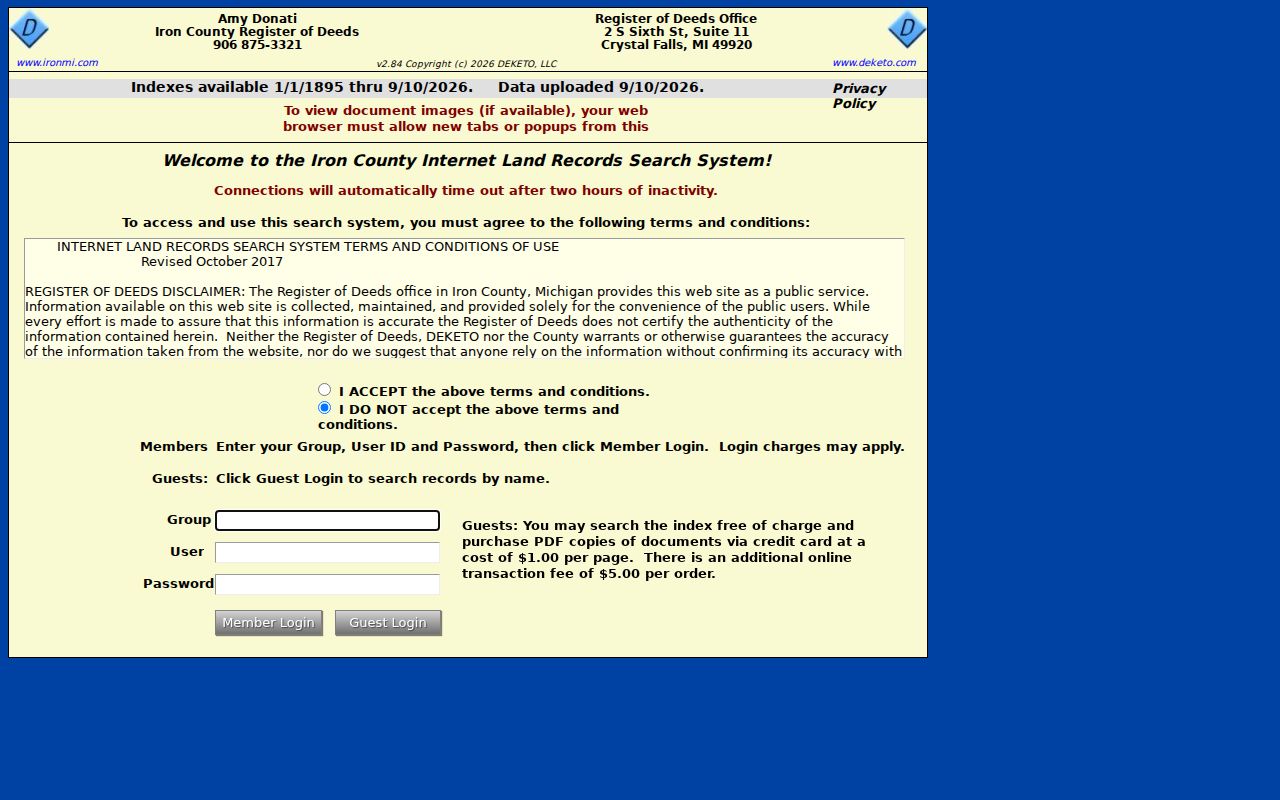
A portal index entry is only a lead. It names a candidate deed. The instrument's full text and legal description decide whether it truly belongs in the chain, so the courthouse and mail routes stay part of any complete workflow.
Check Every Link in an Iron County Former-Owner Chain
A chain works as a research log, not a bare name list. For each transfer, capture the recording date, grantor, grantee, deed type, book/page or instrument number, and the exact land description. Differences get flagged, not smoothed over.
| Transfer date | Grantor to grantee | Deed type | Book/page |
|---|---|---|---|
| Newest verified instrument | Current seller to present grantee | As indexed and confirmed in deed | Record exact citation |
| Prior verified instrument | Earlier owner to later owner | Note warranty, quitclaim, fiduciary, or other form | Record exact citation |
| Earlier volume | Names from vault index | Read the instrument | Carry forward book/page |
Why does a step go missing? The cause may be a name variant, probate transfer, corporate merger, parcel split, sheriff's deed, or a shift to a historic place name. The dedicated Iron County deed records guide handles access to individual instruments, while this page stays on reconstructing the sequence.
How Far Back Iron County Former Owners Can Be Traced
Iron County publishes no official online cutoff. How far back you can trace former owners depends on the source and the parcel. The active scanning notice reaches from 1938 backward into the 1800s. Courthouse books and recorded plats can push an investigation earlier. Archive guides, library materials, and older tax references can help too. That notice is not a completeness claim. Assign the county no unverified "first deed year."
Work backward until the deed trail reaches the earliest available local conveyance or a patent-era source. Then state the limit plainly. A title professional may be needed for insurable title, unresolved interests, or legal conclusions. Former-owner research can document house and land history. It is not itself a title opinion.
Lawful use. Research Iron County former owners for property history, estate work, or due diligence, never to track, threaten, or harass a living person.
Build an Audit Trail for Iron County Previous Owners
Keep a separate line for every instrument. Never overwrite the spelling that appears in the source. A useful log includes the indexed name and the name as signed. Add the recording date and instrument date. Note the deed form, parcel description, and book and page. Record the site where the item was found. Note whether you saw the full image or only an index entry. That distinction matters. The online service can fail, or a historical volume may not be imaged yet.
Anchor the chain at the newest verified instrument. If two deeds carry similar names but different descriptions, pause. Search spouse names, initials, company names, and spelling variants. Then compare adjoining-owner calls or subdivision details in the deed. Iron County's Register records land papers beyond deeds. Easements, leases, mortgages, releases, liens, powers of attorney, and other land papers are recorded as well. Those instruments may explain a name or legal interest. They should not be inserted into the ownership sequence as though each were a conveyance.
A deed naming an LLC or corporation points to the Michigan business registry. It can identify entity names and filings through its newer MiBusiness Registry Portal, launched in 2025. An entity record is a cross-reference. It is not proof that a person personally owned the land. Preserve the deed's named grantee as the owner in the chain. A later recorded instrument can change it.
Request Missing Iron County Ownership Records Precisely
A strong request gives the Register of Deeds a narrow target. Include both party names, approximate year, and land description. Add the last known book/page or instrument number. The office offers counter, public-terminal, phone, and mail access in addition to its county-linked index. A record may be public but not reached through those normal routes. For those cases, Iron County publishes a Freedom of Information Act request form and procedures under Michigan FOIA.
Never ask staff to certify a complete chain or decide title. The official Register page states that the office performs only simple searches. It does not prepare documents. It does not perform an in-depth title search. Ask instead whether a named volume exists and where it can be reviewed. Also ask what information is needed for a copy. For legal certainty about ownership interests, encumbrances, or gaps, use a qualified title professional.
The same precision helps at libraries and archives. Supply the old locality, subdivision or township description, surname variants, and year range. For Iron River, include Stambaugh and Mineral Hills when the period calls for them. Some Caspian property was described in the Village of Palatka plat. Keep Palatka in the search vocabulary. These are documented historical crosswalks. They are not permission to assume every parcel in the modern city used the older label.
Know When an Iron County Former-Owner Chain Is Complete
A chain is complete only for its stated purpose. Each owner transition must rest on an instrument describing the same land. Every unexplained gap should be disclosed. Completeness is always bounded by a date range and the records actually inspected. An index-only search cannot establish that no other recorded interest exists. The county has not published web coverage dates.
Close the project with a source list and a short limitations note. Identify any deed image not seen. Note any volume not checked. Flag any parcel-number change, unresolved estate step, or uncertain historical place name. That candid ending keeps the work useful for house history and due diligence. It avoids any false claim that the result is a certified abstract or title search.