
Iron County Deed Records Explained
The Iron County Register of Deeds accepts more than 200 kinds of instruments for filing. Deed records capture conveyances between owners. The wider land index also covers security interests, access rights, mineral interests, and legal authority tied to land.
| Deed Type | What It Does | Common Use |
|---|---|---|
| Warranty deed | Conveys an interest with stated title covenants. | Ordinary sale transfer. |
| Quitclaim deed | Conveys whatever interest the grantor has. | Family or corrective transfer. |
| Land contract | Records an installment purchase arrangement. | Seller-financed purchase. |
| Personal representative deed | Conveys land through an authorized estate. | Probate sale or distribution. |
| Sheriff's or tax deed | Records a statutory distressed-property transfer. | Foreclosure or tax process. |
Every instrument does something different. A deed transfers an interest, while a mortgage or lien claims one or secures a debt. The label on the first page rarely tells the whole story, so read the full document for reservations, exceptions, easements, or a life estate.
Iron County's Recording Office
Land instruments are kept at 2 South Sixth Street in Crystal Falls. The combined County Clerk and Register holds them. The counter is open to the public on weekdays. Hours run roughly 8 a.m. to 4 p.m. Staff will run simple searches for visitors. They cannot draft documents, give legal advice, or perform a full title search.
Register of Deeds
Suite 9, Crystal Falls courthouse
Phone: 906-875-3221
Counter, phone, mail, and online-index routes
Historical requests
Ask for deed books, vault records, older index references, and copy options when the web index is incomplete.
Give the office the parties' names, the instrument type, a date span, the parcel number, and the legal description. A request that precise is far less likely to miss a record filed under a spelling variant.
Work Iron County's Deed Chain
A grantor-grantee chain links each transfer through party names and the same land description. Begin with the newest owner clue you trust. Then work backward one conveyance at a time. A matching name alone proves nothing, since the same land description must carry the chain forward.
- Find the current assessed name and the exact parcel legal description.
- Search that name as grantee to locate the deed by which the party acquired the land.
- Read the matching description, recording date, and any prior reference.
- Carry that deed's grantor backward and search for the grantor's acquisition.
- Repeat while checking mortgages, releases, easements, and probate transfers.
- Grantor
- The person or entity transferring an interest.
- Grantee
- The person or entity receiving an interest.
- Chain of title
- The linked sequence of instruments affecting ownership.
- Book/page or instrument number
- The recorder's reference used to retrieve a filing.
The county publishes no start year for its online deed index. So when web results stop, that end point is not evidence the chain itself ends there.
Iron County Deed Index Limits
The county links to ironcountyrecords.com for its records portal. Availability of that site can vary from day to day. Exact search labels, date filters, and the online cutoff may differ from what a visitor expects. Buyer and seller names are indexed after imaging. That still leaves open how much of the older material is searchable online.
| Search item | Known status | Practical response |
|---|---|---|
| Grantor or grantee | Buyer/seller indexing confirmed; labels unavailable. | Try name variants and match the land. |
| Document type/date | Many types exist; filters unverified. | Give staff a type and date range. |
| Image or payment | County links a payment route; access unknown. | Ask for the current copy method and fee. |
The captured deed site shows the access issue:
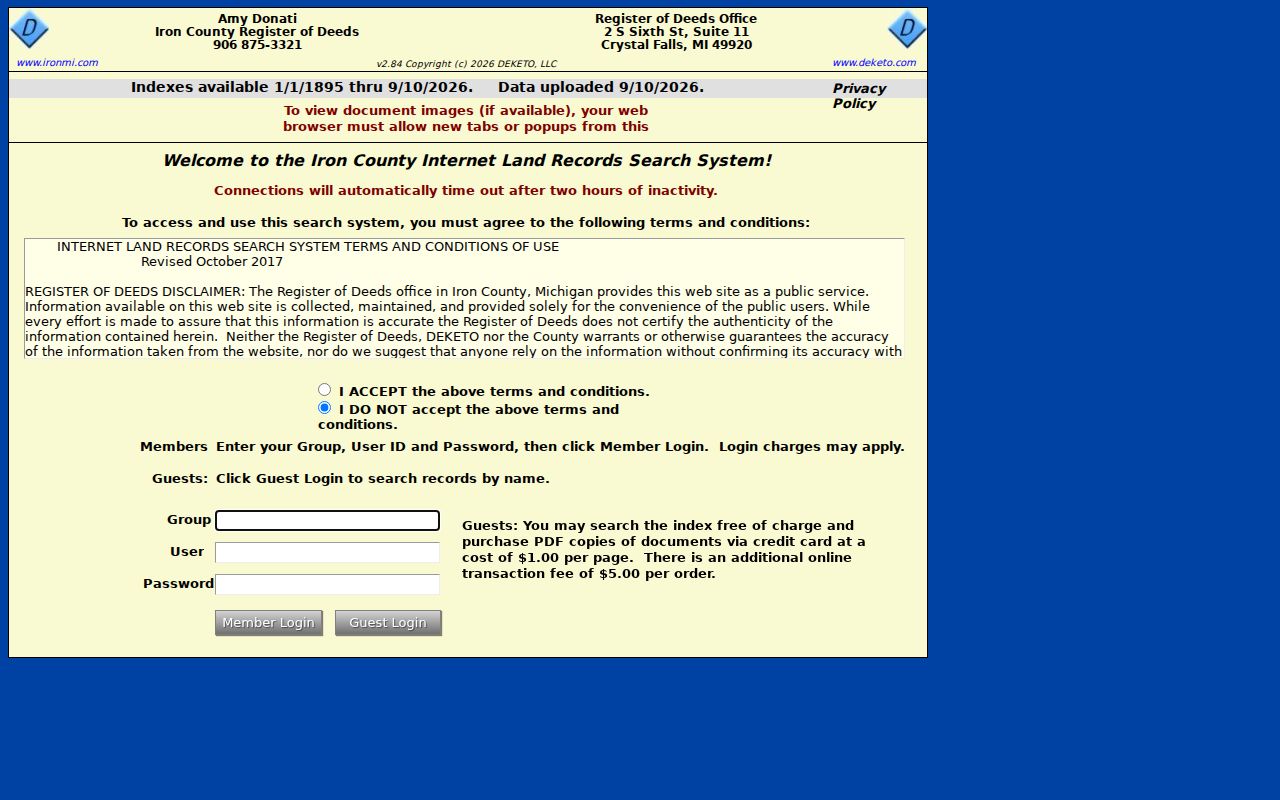
This is evidence for the fallback route, not an individual deed result.
Iron County's 2026 Deed Scan
A current county notice names On Q Solutions as the scanner. It is digitizing deeds from 1938 back through the 1800s. Miscellaneous vault records are part of the project too. That is a major access project for Iron County property records. It does not mean every page has been indexed, checked, or posted. Ask the Register what years are available when you search.
Older work may still call for physical indexes, deed books, or vault retrieval. Record every party spelling, book and page, date, and legal description as you go. Those details let staff bridge the gap where online access stops.
Note: An active scan project expands access over time but does not establish a complete online cutoff.
Match Iron County Deeds to Plats
City deeds often carry lot-and-block descriptions tied to a named plat. Local examples include Burns Addition and 2nd Addition to Plat of Caspian. Crystal Falls assessor plats are another source. Rural deeds lean on section, township, and range calls. Some use a government lot. Others rely on metes and-bounds descriptions.
Michigan's OLSR can locate subdivision plats. Choose "Plat Record," then open the additional criteria. Select Iron County and enter a partial subdivision name. You can also enter the section, town, and range. Open the record and its attachments; multi-page plats download as separate files. A plat explains the description itself. It will not name the present owner of record on its own.
Read Beyond Iron County Deeds
A careful deed search looks past the latest conveyance. Mortgages reveal security interests, releases show later action, and easements can burden one tract while benefiting another. Liens, leases, powers of attorney, and mineral documents may explain rights the newest deed never mentions.
- Search current and prior owner names.
- Use the legal description when a name is broad.
- Pair each mortgage with a release or discharge.
- Inspect easement descriptions and cited plats.
- Check probate when an estate appears.
Note: A transfer-tax exemption on a deed does not prove that no value changed hands or that the land is free of claims.
Iron County Deed Fraud Alerts
The Register offers a free property-fraud alert with simple sign-up instructions. A registrant supplies an email address plus the names to monitor. When a matching name is indexed, the service sends notice. It does not block recording or judge a document's validity. The official fraud-alert instructions appear here:
Register any allowed person, trust, or entity variant, then report unfamiliar notices.
Estate Transfers in Iron County
Death can break an ownership chain in Iron County. The next land record rarely resembles a routine sale. The parcel may sit in limbo for a while. Search the decedent first. Then widen the property search to the spouse, any trust, the personal representative, an executor or administrator, and known heirs. Probate records matter too. Someone needed legal authority before that land could be sold or divided. A death certificate helps confirm identity and dates, but it conveys nothing.
The instrument that finally enters the deed records might take several forms. It could be a personal representative deed. It could also be a survivorship document, an affidavit, a trust-related deed, or a later deed signed by the heirs. Compare the probate order against the land description filed with the Register. Check the tax roll as well. If the decedent still shows as owner of record, the assessor may simply be behind on updates. A later deed could still exist in the recorder's files.
Probate answers who held authority. The recorded conveyance shows what actually entered the county land record.
Check Each Iron County Instrument
Read every Iron County instrument closely before it joins a chain of title. Confirm the full legal description first. Check that grantor and grantee roles match the transaction. Note both the execution date and the recording date, since a deed can be recorded long after it was signed. Cited prior filings deserve a look too. Reserved minerals, easements, life estates, survivorship language, and exceptions can all hide inside boilerplate. That boilerplate can look routine.
Each instrument type raises its own questions. For a mortgage, hunt for the later discharge, release, or satisfaction that clears it. For a lien, identify the claimant and the affected land. Note the filing date and any later discharge or judgment. For an easement, decide which tract benefits and which carries the burden. A GIS map line cannot settle those terms; only the recorded language can.
Michigan deeds sometimes name an LLC as a party. The state's MiBusiness Registry can confirm the entity's exact name and filing roles. That helps with identity questions. The deed itself still links the land to Iron County.
Request an Iron County Deed Copy
The index is usually the fastest route, but counter, phone, and mail requests all work. Give the Register of Deeds the grantor, the grantee, an approximate date, the deed type, the parcel number, and the legal description. An index reference helps when you have one. Ask whether you need an ordinary copy or a certified one. Confirm the current price. No specific deed-copy fee is published.
Electronic recording through approved vendors serves lenders, title agencies, and attorneys. Some items stay outside that system in Iron County. These include sheriff's deeds, surveys, plats, corner records, court-certified documents, and vital certificates. Those records remain public. Access simply runs through the proper office instead.
A plain copy serves most research purposes. A certified copy bears the custodian's certification, which formal use requires. State your purpose when asking which product fits. Order the complete instrument, not just its signature page. Exhibits and attached legal descriptions may define the land or reserved rights. Then compare the page count and reference against the index entry.
When routine channels come up empty, the county's written FOIA form can describe the parties, parcel, instrument, and date range. Try the normal Register request first. FOIA does not require a title report or legal answers. Ask about allowable search, review, copy, and mailing charges before any large request begins.
Recorded, not guaranteed. Recording alone does not prove that the grantor held clear title, that the deed is valid, or that no unrecorded interest exists.